


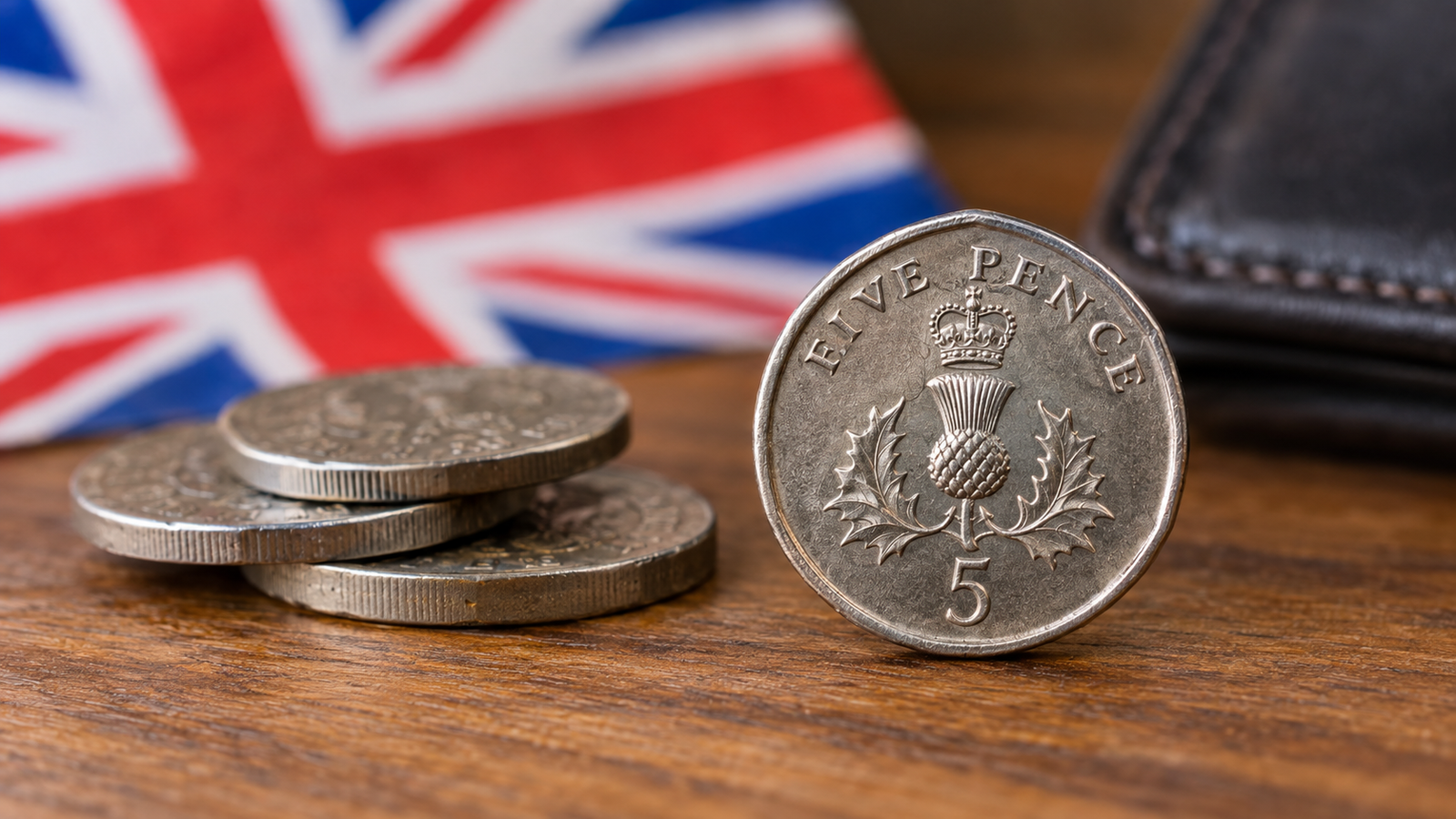
The 5p coin is one of the smallest denominations in the United Kingdom, but some examples are much more interesting to collectors than their face value suggests. Dates, mintage figures, design changes, condition and unusual errors can all affect a coin’s collector appeal.
The modern 5p has been in circulation since 1968, although the original coin was much larger than today’s version. The smaller 5p arrived in 1990, while the reverse design changed again in 2023 with the introduction of King Charles III’s definitive coinage.
So, which 5p coins are valuable today? The answer depends heavily on the specific year and condition. A 5p being old does not automatically make it rare or expensive.
What Is a 5p Coin?
A 5p coin is a UK decimal coin worth five pence, or £0.05. It is one of the eight denominations used in Britain’s circulating coinage.
The first 5p was introduced in 1968 ahead of decimalisation and was based on the pre-decimal shilling. The original 5p was the same size as the shilling and continued circulating alongside it until the shilling was demonetised in 1990.
The current smaller 5p measures 18mm in diameter and weighs 3.25g. It has a milled edge and is made from nickel-plated steel. Older examples were made from cupro-nickel before the material change.
5p Coin Weight, Diameter and Size
If you are checking a coin at home, its measurements can help identify whether you have a standard modern 5p.
| Specification | Modern UK 5p |
|---|---|
| Face value | 5 pence |
| Diameter | 18.00mm |
| Weight | 3.25g |
| Thickness | 1.7mm |
| Edge | Milled |
| Current composition | Nickel-plated steel |
| Legal tender limit | Up to £5 |
The Royal Mint confirms that the current 5p weighs 3.25g, rather than exactly 3g. Small differences can occur through normal wear, dirt or measurement accuracy, so a kitchen scale is not a substitute for professional identification.
What Was the Size of the Old 5p?
The original large 5p was considerably bigger. It measured approximately 23.59mm, compared with 18mm for the smaller version introduced in 1990.
The Royal Mint says the reduction was made after a review of UK coinage, with research indicating that people generally found the coins in their pockets too heavy and bulky.
This means collectors may encounter two distinctly different physical sizes when looking at older 5p coins.
5p Coin Designs Through the Years
The 5p has had several important design and portrait changes.
The earliest decimal 5p featured Queen Elizabeth II’s second portrait by Arnold Machin. From 1985, the obverse changed to Raphael Maklouf’s portrait. Later coins used portraits by Ian Rank-Broadley and Jody Clark before King Charles III’s portrait by Martin Jennings appeared on the new definitive design.
The reverse has also changed.
For many years, the 5p used Christopher Ironside’s crowned thistle design. In 2008, the reverse became part of Matthew Dent’s Royal Shield design. The next major change came with King Charles III’s definitive coinage.
The 2023 5p Coin With King Charles III
One of the most recognisable modern 5p coins is the 2023 5p coin with King Charles III.
The coin features King Charles III’s official portrait on the obverse. Its reverse displays an oak tree leaf, part of a new series of UK definitive designs inspired by British flora and fauna.
The Royal Mint explains that the oak leaf represents the importance of the oak tree as a habitat for biodiversity and reflects the long association between oak leaves and monarchies.
Although the coins are dated and minted in 2023, they did not enter general circulation until 2025. The Royal Mint announced that 23.2 million of these 5p coins were being released into circulation in 2025 following demand for the denomination.
That distinction is useful for collectors: a 2023 date does not necessarily mean the coin entered circulation in 2023.
What Is the 5p Coin With a Leaf?
The modern 5p coin with a leaf is the King Charles III definitive 5p.
The leaf is taken from an oak tree. It forms part of the new definitive series unveiled in 2023, replacing the previous shield-based designs.
The design is therefore not, by itself, an error or proof that a coin is exceptionally valuable. Its collector interest comes largely from its significance as the first circulating 5p bearing King Charles III’s portrait and from its new design.
What 5p Coins Are Worth Money?
Most circulated 5p coins are worth their face value of 5p. Collectors generally look for coins with unusual dates, lower mintages, scarce varieties, exceptional condition or genuine minting errors.
One of the most important examples is the 1977 5p.
1977 5p Coin
The 1977 5p is particularly interesting because it has the lowest mintage recorded for the denomination, according to The Royal Mint.
The Royal Mint’s current information gives the mintage as 24,308,000. It carries Queen Elizabeth II’s Arnold Machin portrait and the traditional crowned thistle reverse.
That makes the 1977 issue a date collectors may want to identify, but low mintage does not automatically establish a particular market price. Actual prices depend on condition, demand and the circumstances of a sale.
2025 Oak Tree Leaf 5p
Another notable issue is the 2025 oak tree leaf 5p.
The Royal Mint currently lists 19 million as the mintage for the 2025 5p, describing it as the lowest mintage of its type. The design is based on the oak leaf introduced with the King Charles III definitive coinage.
It is important to distinguish between low mintage and high monetary value. A coin can have a relatively low mintage without commanding a large premium in the secondary market.
Which 5p Coins Are Rare?
If your goal is to find rare 5p coins, start with the date rather than assuming that every old-looking coin is valuable.
The Royal Mint’s published information identifies the 1977 5p as the lowest-mintage 5p issue to date, at 24,308,000.
The 2025 oak leaf 5p, with 19 million issued, is another comparatively low-mintage modern example.
Collectors should also pay attention to:
- Very low mintage years
- Older large-size 5p coins
- Genuine striking errors
- Unusual varieties
- Coins in particularly high-grade condition
- Uncirculated or proof examples
- Coins with clear provenance
However, online listings can sometimes give an unrealistic impression of 5p coin value. An advertised price is not necessarily the same as the amount a collector has actually paid.
Does a 5p Coin With an Error Have Extra Value?
It can, but the error needs to be genuine.
Possible minting errors can include problems with the strike, lettering, alignment, planchet or other production characteristics. Ordinary damage caused after a coin leaves the Mint is different from a manufacturing error.
For example, scratches, dents, discolouration and flattened edges may simply result from years of circulation. They do not automatically make a coin rare.
If you think your 5p has an unusual error, avoid cleaning or polishing it. Altering the surface can reduce collector interest and make authentication more difficult.
Which 5p Coins Are Legal Tender?
A 5p coin is legal tender in the UK for amounts up to £5. The Royal Mint explains that legal tender has a specific technical meaning concerning the settlement of debts; it does not mean every shop is required to accept every coin for every transaction.
This is an important distinction.
For everyday purchases, a retailer can have its own payment policies. Legal tender rules do not mean you can necessarily hand over any quantity of 5p coins at a shop and demand that they be accepted.
How Much Is a 5p Coin Bag Worth?
A standard calculation is simple:
100 × 5p = £5
So a bag containing 100 standard 5p coins has a face value of £5.
Using the modern specification of 3.25g per coin, 100 modern 5p coins would weigh approximately 325g, before allowing for the weight of the bag or any variation caused by wear and manufacturing tolerances.
This makes the 5p coin bag weight roughly 325g for 100 modern coins.
The actual contents and packaging of a bank or cash-handling bag can vary, so a bag’s physical weight should not be treated as a guaranteed identification method.
What Is the 5p Coin Value in a Collection?
There is no single collector value for every 5p coin.
A useful way to assess one is to consider these factors:
- Year – Some dates have lower mintages than others.
- Size – Determine whether it is the original large 5p or the smaller modern type.
- Design – Check the reverse and the monarch’s portrait.
- Condition – Sharp details and limited wear can increase collector interest.
- Errors or varieties – Genuine production abnormalities can be significant.
- Provenance – A documented history can help with unusual pieces.
- Market demand – Collector interest affects actual selling prices.
A 5p coin that appears unusual should therefore be identified before assigning it a price.
What About a 5p Coin From Jersey or the Bailiwick of Jersey?
You may also encounter searches for a 5p coin Bailiwick of Jersey.
Jersey has its own coinage, and Jersey coins should not automatically be treated as standard UK Royal Mint circulating coins. Although Jersey’s currency is linked closely with sterling, collectors should identify the issuing authority and design before comparing a Jersey 5p with a UK 5p.
This distinction matters when researching rarity, mintage and resale prices.
What About an Australian 5p Coin or an Argentine 5p Coin?
There is no standard Australian or Argentine denomination equivalent to the UK’s 5p in the same sense.
An Australian 5-cent coin is a different denomination and currency, while an Argentine coin described informally as a “5p” should be identified by its actual denomination and issuing country.
If a search result or marketplace listing calls a foreign coin a “5p coin”, check the coin itself rather than assuming it is a British five pence piece.
For UK collectors, the key identifiers are the denomination, country of issue, date, portrait and design.
How to Check Your 5p Coin
If you have a handful of old coins and want to know whether any are worth keeping, follow a simple process.
1. Check the date
Start with the year shown on the coin. Dates associated with lower mintages deserve closer attention.
2. Look at the size
An older large 5p is noticeably bigger than the modern 18mm version. The Royal Mint confirms that the smaller coin replaced the larger type in 1990.
3. Examine both sides
Look at the monarch’s portrait, lettering, date and reverse design. A magnifying glass can help reveal details that are difficult to see with the naked eye.
4. Weigh it
A modern 5p should weigh about 3.25g according to Royal Mint specifications.
5. Check for genuine errors
Compare the coin with reliable reference images before assuming an unusual mark is a mint error.
6. Avoid cleaning it
Do not polish a potentially collectible coin simply to make it look newer. Original surfaces can be important to collectors.
7. Compare actual sales
If you want to estimate market value, look for completed sales of the same date, design and condition rather than relying only on active listings.
Is a 5p Coin Worth Keeping?
Some are certainly more interesting to collectors than others, but most ordinary circulated 5p coins remain worth their face value.
The strongest reasons to put a 5p aside for further research include a scarce date, unusual size, recognised variety, genuine mint error, excellent condition or historical significance.
The 1977 issue is particularly notable because The Royal Mint identifies it as the lowest-mintage 5p to date. The King Charles III oak leaf 5p is also historically interesting because it represents a major change in the UK’s circulating 5p design.
Frequently Asked Questions About 5p Coins
Is 5p a coin?
Yes. A 5p is a British decimal coin with a face value of five pence. It has been part of the UK’s decimal coinage since 1968.
How much does a 5p coin weigh?
The current UK 5p weighs 3.25 grams and has a diameter of 18mm.
What is the rarest 5p coin?
The Royal Mint currently identifies the 1977 5p as the lowest-mintage 5p, with 24,308,000 issued.
What is the 2023 5p coin with the oak leaf?
It is the new definitive UK 5p featuring King Charles III’s portrait and an oak leaf on the reverse. Although dated and minted in 2023, the coins entered general circulation in 2025.
Are all old 5p coins valuable?
No. Age alone does not determine collector value. Mintage, condition, rarity, errors, varieties and collector demand all matter.
How much is a bag of 5p coins worth?
If the bag contains 100 standard 5p coins, its face value is £5. One hundred modern 5p coins would weigh approximately 325g, excluding the bag itself.
Final Thoughts
The humble 5p coin has a surprisingly interesting history. From the large shilling-sized coin introduced in 1968 to the smaller 5p introduced in 1990 and the King Charles III oak leaf design released into circulation in 2025, the denomination has changed considerably over the decades.
For collectors, the date is a sensible place to start. The 1977 5p stands out for its low mintage, while the King Charles III oak leaf 5p is notable as a major modern design change. But neither age nor a new monarch’s portrait automatically guarantees a high resale price.
If you find an unusual 5p, identify its date, size, design and condition first. Those details provide a much more reliable starting point for understanding its potential collector interest than an eye-catching online asking price.




Leave a Reply